Our Pick: Top 5 Crystals for PTSD
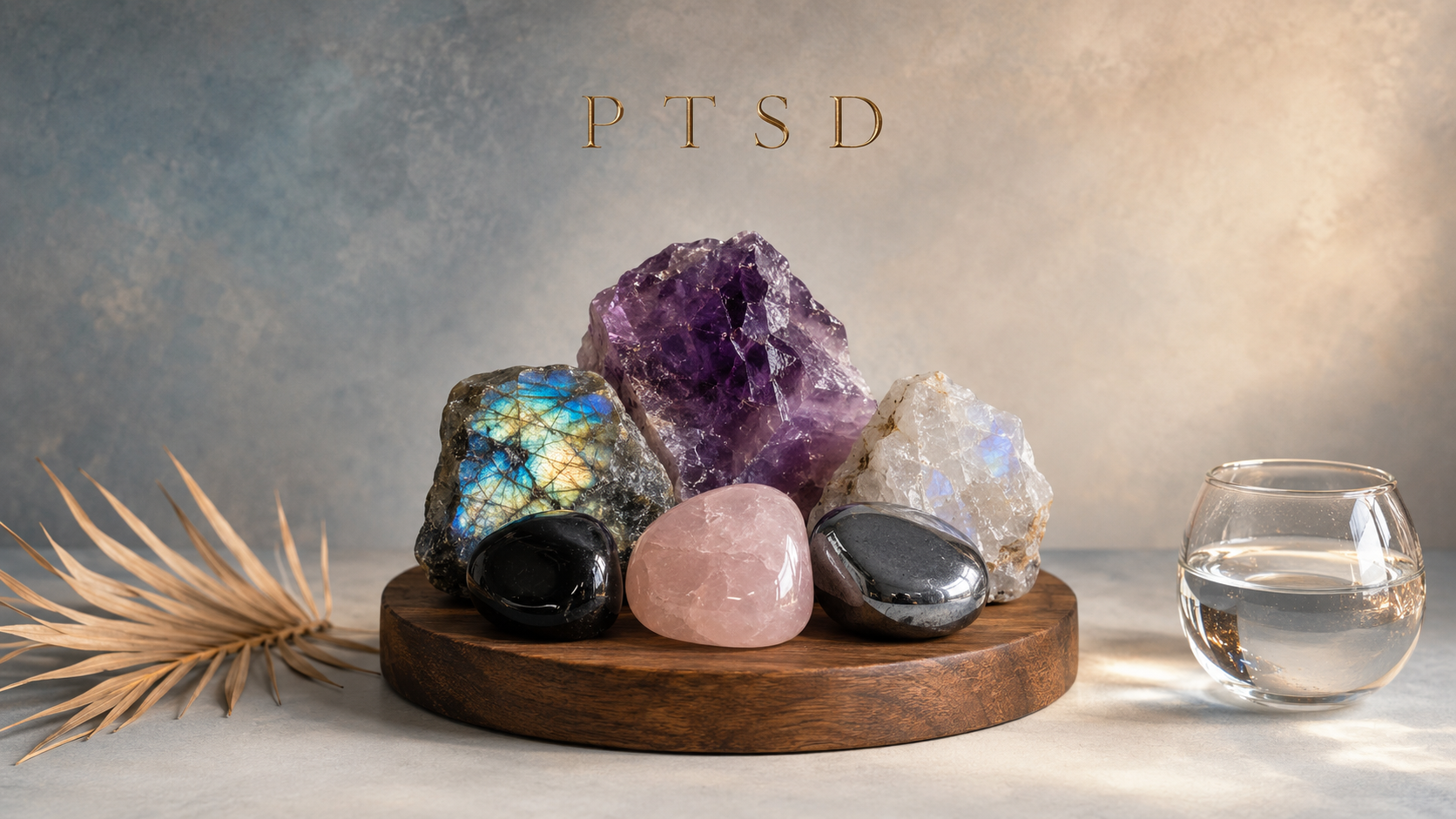
Reclaiming Your Ground: Crystal Support for PTSD
Trauma has a way of staying present long after the event itself has ended, showing up in a racing heart at an unexpected trigger, a body that stays braced even when nothing is actually threatening it in the moment. Healing from something like this rarely moves on a predictable schedule, and resilience isn't the absence of that struggle so much as the willingness to keep showing up for the slow, uneven work of recovery. Emotional recovery asks for real patience, since a nervous system that's learned to expect danger takes time to genuinely relearn safety, longer than most people would like and exactly as long as it actually takes. Support matters enormously here, both from others and from small, steady practices that help a person feel less alone in the middle of it. Grounding and safety, the deep, physical kind rather than merely the idea of it, tend to be what the body is actually asking for before anything else can follow. Self-compassion may be the hardest piece of all, extending yourself the same patience you'd offer someone else going through exactly this. There can be small, grounding companions for the ongoing work of feeling safe in your own body again.
Apache Tears offers a slow, gentle steadiness, a quiet companion for releasing what's ready to be let go without demanding it happen on any particular timeline. Named for a legend of shared grief, they carry that same unhurried, patient quality into whatever a person is actually moving through, cleansing old emotional wounds held below conscious awareness. Apache Tears is particularly suited to processing something heavy at whatever pace actually feels survivable, rather than a pace someone else has decided should be reasonable. It supports staying with difficult material long enough to genuinely move through it, without forcing a resolution before you're actually ready for one. Recovery from something significant rarely follows a tidy schedule, and expecting it to can add pressure that makes the actual work harder rather than easier to sit with day to day. For anyone whose healing has felt like it's supposed to move faster than it actually can, Apache Tears offers permission to let it take the time it needs, without a deadline attached to it.
Moonstone offers a soft sense of security, a steady light through unsettled moments when the ground itself can feel less reliable than it should. Long connected to lunar rhythm and quiet emotional stability, it soothes the kind of instability that trauma can leave behind, an unpredictability in mood or memory that doesn't always follow a clear pattern. Moonstone is often reached for during the specific unpredictability recovery can bring, a good stretch followed by a harder one for no obvious reason at all. It supports staying gentle with yourself through that unevenness rather than reading it as a setback or a sign that nothing is actually improving. A harder day after several better ones doesn't erase the progress that's already happened; it's simply part of how healing tends to move, more like weather than a straight line climbing steadily upward. For anyone whose progress has felt inconsistent in a way that's discouraging to sit with, Moonstone offers a steadier light to hold onto through it.
Labradorite wraps you in a gentle shield, giving you space to process at your own pace rather than feeling exposed while you do the work of healing. Considered one of the most powerful protective stones in the mineral kingdom, it creates a shielding presence throughout the aura, supporting a felt sense of safety while difficult material surfaces and gets worked through. Labradorite is especially useful for anyone who feels unusually raw or exposed during the early stages of processing something significant, when even ordinary interactions can feel like more than usual. It supports having a protective boundary in place so that necessary processing doesn't feel like it's happening without any defenses at all, unprotected against a world that keeps moving at its ordinary pace regardless of what you're privately working through. Some people find it useful to carry a piece specifically on days with therapy appointments or other emotionally demanding commitments, a small reinforcement for a day that's already asking more of them than usual. For anyone who's felt unusually exposed while doing this difficult work, Labradorite offers the shield to do it with some real protection around you.
Rose Quartz encourages the same tenderness toward yourself that you'd offer someone you love, which tends to be the hardest tenderness to actually extend inward. Known as the stone of unconditional love, it dissolves the harsh self-judgment that can accompany trauma, the sense that healing should somehow be happening faster or look different than it currently does. Rose Quartz supports treating yourself as someone worthy of patience and care during this process, not someone falling short of some expected recovery timeline. It encourages self-compassion specifically, since criticism rarely speeds up healing and often just adds another layer of difficulty on top of what's already hard to carry. Most people would never tell a friend working through something this significant that they should already be further along, and yet that exact message often gets aimed inward without a second thought. For anyone who's been harder on themselves than they'd ever be on a friend in this position, Rose Quartz offers the tenderness to soften that instead.
Amethyst brings a quiet calm, creating space to breathe and reconnect with yourself when everything has felt like too much to process at once. Revered throughout history for its stilling, purifying qualities, it opens the Third Eye and Crown chakras together, supporting a genuine internal quiet that can be hard to access after significant distress. Amethyst is often kept close during moments that call for simply pausing, a few minutes to breathe before returning to whatever the day is asking of you. It supports finding calm without needing to have fully processed everything first, a brief respite rather than a complete resolution, and those small respites matter even when nothing about the larger situation has actually changed yet. A few genuinely quiet minutes, away from a screen and away from the day's demands, can be enough to reset a nervous system that's been running on alert for longer than it should have to. For anyone who's needed a moment to simply breathe before continuing forward, Amethyst offers the calm space to actually take one.
Hematite offers a grounded sense of steadiness, helping you feel rooted and present in your body rather than pulled away from it by memory or anticipation. Dense and metallic, it's considered one of the most reliably grounding stones available, harmonizing mind, body, and spirit into something more coherent than distress tends to allow on its own. Hematite is particularly useful for the specific disconnection trauma can create, a sense of watching your own life rather than fully inhabiting it in the present moment. It supports coming back into your body gently, useful in the exact moments a mind starts drifting toward memory rather than staying with what's actually happening now in the room around you. Something as simple as holding a cool, solid object and naming a few concrete details about the present moment, what you can see, what you can feel under your hands, can help interrupt that drift before it pulls you too far from the here and now. For anyone who's felt disconnected from their own body more often than they'd like, Hematite offers an anchor back into it.
Trauma rarely resolves on command — it eases gradually, through safety, grounding, and enough self-compassion to meet a slow process without added judgment. Apache Tears and Rose Quartz support the patient, self-compassionate pace this work actually requires, easing the pressure to heal faster than is genuinely possible. Moonstone and Labradorite offer steadiness and protection through the unevenness recovery tends to bring, good stretches and harder ones alike. Amethyst and Hematite support returning to calm and to your own body in the moments that call for it most, gently and without forcing anything. None of these stones will finish the work on their own, and that's not what they're for; the actual healing happens through time, support, and often professional care, with these serving as a small, physical reminder to keep showing up for it. These stones aren't a substitute for professional trauma support, but they can offer a steady, comforting presence alongside it, a small companion for the ongoing work of feeling safe in yourself again, one gentle day and one gentle moment at a time.