Our Pick: Top 5 Crystals for Imposter Syndrome
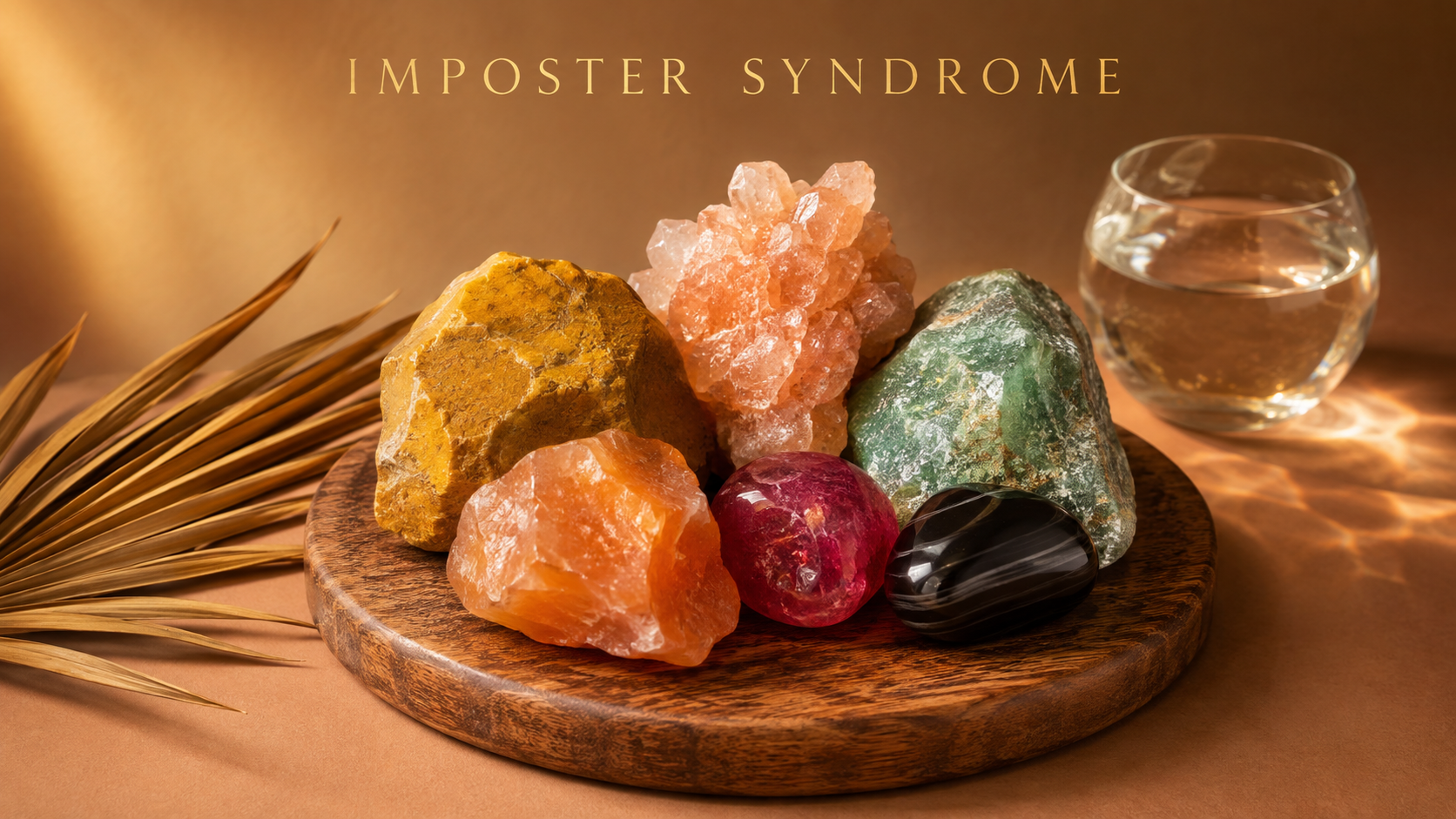
Trusting What You've Actually Built: Crystal Support for Imposter Syndrome
Imposter syndrome has a way of following success around rather than fading once you've achieved it. Confidence and self-worth can feel strangely disconnected from actual accomplishment, as if evidence of your own competence simply doesn't register the way it should. Visibility becomes its own particular challenge — the more seen you are, the louder the fear of being exposed as somehow less capable than you appear. Authenticity gets complicated when part of you suspects the version of yourself succeeding isn't quite the real one. Courage and self-belief matter enormously here, not as the absence of doubt but as the willingness to keep showing up despite it. Leadership, especially, tends to amplify these feelings, since responsibility for others can make self-doubt feel higher stakes than it actually is — a single mistake in front of a team can feel like proof of something, when really it's just what learning on the job looks like for everyone. None of this reflects your actual competence, even when it's convincing in the moment. There can be small, grounding companions for trusting what you've genuinely built.
Yellow Jasper builds genuine confidence from the inside out, creating real self-assurance rather than the performance of it — a quiet trust that showing up as yourself is enough, without needing to perform a more polished version. It channels steady, sustained energy through the Solar Plexus chakra, attracting opportunities that align with who you actually are rather than a character you feel pressure to maintain, which matters most in the meetings where staying quiet feels safer than speaking up as yourself. Yellow Jasper brings emotional clarity to situations that feel murky, useful when imposter syndrome has clouded an otherwise clear-eyed view of your own capability. It supports steady self-trust rather than a fragile confidence that needs constant reinforcement from praise or results before it feels real again. For anyone whose confidence feels like it's being performed rather than genuinely felt, worn a little thinner every time it has to be summoned on demand, Yellow Jasper offers a way to build the real thing, steadily, rather than a version that only holds up under good conditions.
Peach Aventurine offers the quiet confidence to step into new experiences without the pressure of performing perfectly, gently quieting the inner critic that tends to get loudest right before something new or exposing — a presentation, a first day, a conversation you've been putting off. It activates Sacral chakra energy with warmth and softness, easing the low-level anxiety that so often accompanies visibility, the kind that shows up as a tight stomach before you've even opened your mouth. Peach Aventurine invites a gentler relationship with your own growth, permission to move toward what you want without demanding flawlessness along the way. It supports self-acceptance as the foundation confidence is actually built on, rather than something confidence is supposed to be earned into after enough proof accumulates. For anyone whose inner critic gets loud right before a big moment, drowning out whatever preparation actually went into it, Peach Aventurine offers a gentler way to quiet it.
Green Aventurine reinforces leadership confidence, releasing the outdated self-definitions that keep you from trusting your own growth even after you've clearly outgrown them. It's regarded as one of the luckiest stones in the mineral kingdom, not through passive magic but through its capacity to reinforce the decisiveness that creates the conditions for opportunity to actually appear, the kind of steady follow-through that turns a chance into something real. Green Aventurine supports the willingness to embrace change, useful when imposter syndrome keeps you tethered to an old, smaller version of your own capability — the junior version of yourself who hasn't caught up to everything you've since learned and led. It gently releases patterns that no longer reflect who you've become, making room for a self-image that's actually current. For anyone whose self-image has lagged behind their actual growth, still bracing for a level of scrutiny they've long since outgrown, Green Aventurine offers a way to finally catch up to it.
Ruby asks you to take your own value seriously, bringing unyielding self-confidence rather than the performance of it that imposter syndrome so often demands. It's been worn throughout history as a talisman of courage and self-possession, combining personal power with genuine self-regard in equal, mutually reinforcing measure, useful in the rooms where minimizing your own contribution starts to feel like the polite default. Ruby brings clarity of mind alongside its confidence, helping separate genuine self-doubt from the reflexive kind that shows up regardless of actual competence, the doubt that arrives on schedule no matter how well-prepared you actually are. It supports a vitality that comes from taking your own accomplishments at face value instead of quietly explaining them away as luck or timing. For anyone whose confidence has felt performed rather than genuinely owned, held together for an audience rather than for themselves, Ruby offers the unyielding kind instead.
Orange Chalcedony builds quiet self-confidence rooted in feeling emotionally steady, not managed or performed for anyone else's benefit or approval. It carries a nurturing warmth into the Sacral chakra, supporting the kind of self-assurance that comes from emotional wholeness rather than from external validation, the difference between feeling capable and simply being told you are. Orange Chalcedony absorbs negative energy from the environment, useful when imposter syndrome has been fed by comparison or the pressure of other people's expectations, especially in workplaces that reward constant visible output over quieter, genuine competence. It supports giving from genuine capacity rather than from a place of proving yourself, so effort comes from choice instead of anxiety. For anyone whose confidence depends too heavily on outside approval, checking for reassurance before trusting their own read of a situation, Orange Chalcedony offers a steadier, more internal foundation.
Onyx restores rational, clear-eyed thinking and the self-confidence that makes wise decision-making possible, especially when you feel most exposed to judgment. It's a stone of self-mastery, historically used as an amulet of protection and wise judgment across cultures and centuries, worn by people who understood that composure under scrutiny has always been a skill worth cultivating. Onyx calms the nervousness and anxiety that can accompany high-visibility moments, restoring rational thought during periods of real pressure, the kind that can make a straightforward question suddenly feel like a test. It instills steadiness that makes clear thinking possible exactly when circumstances make it hardest, so preparation doesn't disappear the moment attention turns your way — the difference between freezing when a hard question lands and simply pausing long enough to answer it well. For anyone whose thinking clouds most right when clarity matters most, whose mind goes blank in exactly the moments composure would matter, Onyx offers grounded steadiness to think clearly through it, a settled center to return to when the room's attention makes everything feel harder than it needs to.
Imposter syndrome rarely responds to more evidence of competence — it responds to actually trusting the evidence you already have, and trust tends to be built the same slow way competence was: through repetition, not through a single convincing argument. Yellow Jasper and Ruby build the genuine self-assurance imposter syndrome undermines; Peach Aventurine and Green Aventurine release the old self-doubt keeping pace with your actual growth; Orange Chalcedony and Onyx ground that confidence in something steadier than outside approval. Together they speak to the fact that self-belief isn't a fixed trait some people simply have and others don't — it's a practice, rebuilt in small moments long before the big ones arrive. Reaching for one of these stones before a moment that puts you in the spotlight can be a small, physical reminder that you belong exactly where you've earned your place, and that the discomfort of visibility isn't evidence you don't.