Our Pick: Top 5 Crystals for Authenticity
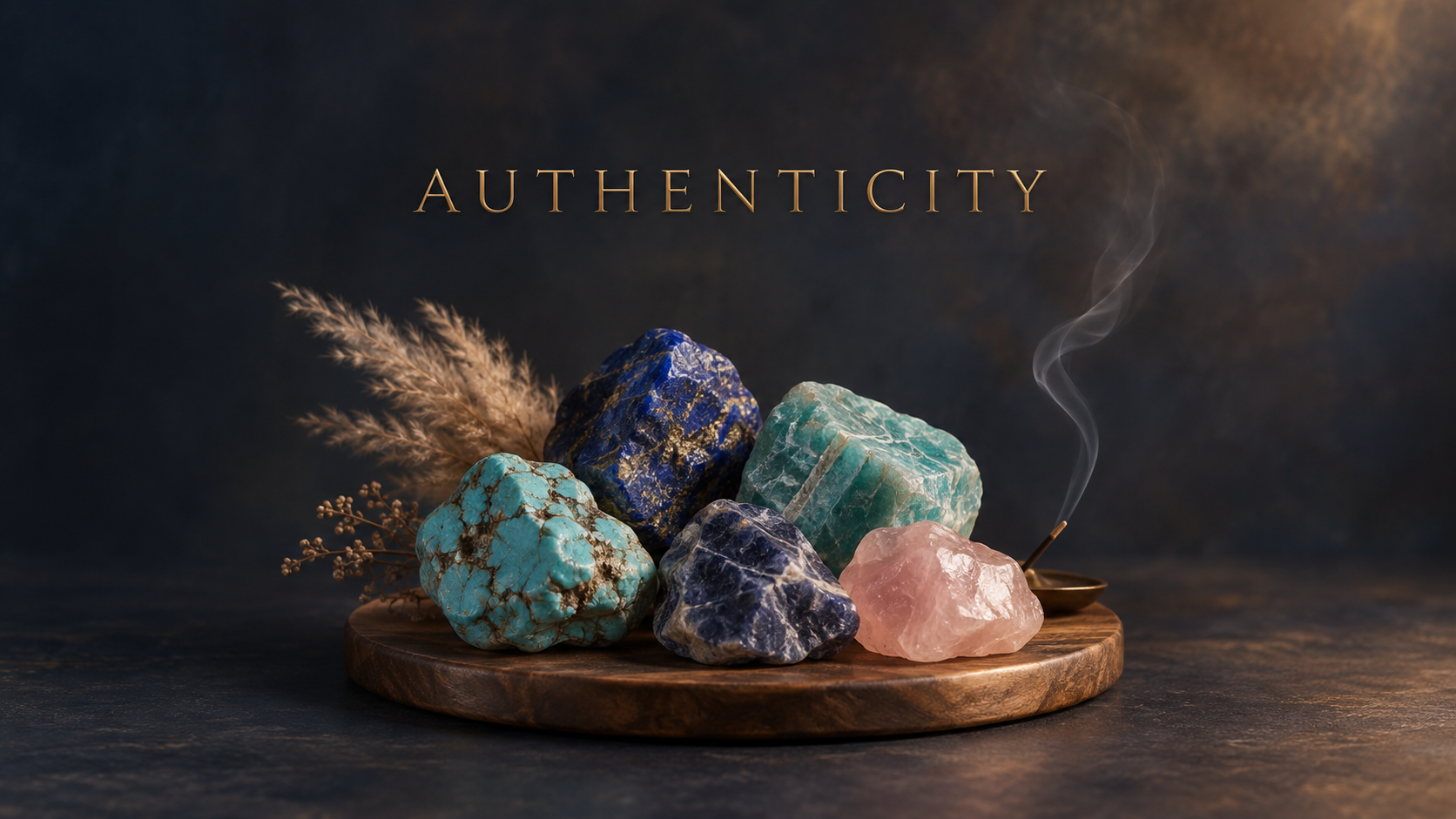
Becoming Fully Yourself: Crystal Support for Authenticity
Authenticity asks something quietly demanding of us: to let our outside actually match our inside, even when performing a more polished or more palatable version of ourselves would be easier. It shows up as the discomfort before saying what you actually think, the tension between the identity you present and the one you privately know is true, or the vulnerability of letting people see an unfiltered opinion instead of a carefully managed one. Real self-expression takes a kind of confidence that isn't loud so much as steady — the willingness to risk being fully seen instead of merely approved of. That's not a one-time decision; it's a practice, one that tends to deepen with genuine personal growth rather than arriving all at once. Honesty toward yourself usually has to come before honesty toward anyone else. There can be small, grounding companions for the practice of becoming more fully who you already are.
Turquoise carries an ancient protective reputation, worn by travelers and truth-tellers across cultures for thousands of years, and that protective quality shows up today less as armor and more as steadiness — the kind that makes honest self-expression feel survivable instead of dangerous. It speaks directly to the seat of the voice, encouraging communication that comes from trusting your own accumulated wisdom rather than performing for whoever happens to be listening. For anyone who's spent years reading a room before speaking in it, Turquoise offers a different instinct: trust what you already know, and let the words follow from there instead of from calculation. It also supports a kind of self-forgiveness that authenticity actually requires — the willingness to have gotten it wrong before, said the performed thing instead of the true one, and try again anyway. Turquoise is for the version of confidence that isn't about being right, but about being real.
Lapis Lazuli has been treasured for over six thousand years, ground into the deep blue pigment used in sacred art and worn by pharaohs as a symbol of a truth that couldn't be bought, faked, or talked around. That history matters here: Lapis Lazuli has always stood for the kind of integrity that has nothing to do with performance and everything to do with alignment — between what you actually understand to be true and what you're willing to say out loud. It offers the clarity to know your own mind and the honesty to speak it, closing the gap that so often opens between private conviction and public presentation. For anyone who's noticed a quiet dishonesty in saying what's expected instead of what's true, Lapis Lazuli offers a steadying push toward closing that gap. It doesn't ask for boldness so much as consistency — the willingness to let your perception and your speech finally match, day after ordinary day. Lapis Lazuli is a stone for people who are tired of managing an impression and ready to simply be one.
Known as the Stone of Courage and the Stone of Truth, Amazonite empowers you to speak what you actually mean without letting fear or the pressure of judgment water down the message before it leaves your mouth. It helps you see a situation from more than one angle, but without using that objectivity as an excuse to avoid taking an actual position — a habit that can look like open-mindedness while functioning as a way to dodge vulnerability. Amazonite supports personal integrity in the small, unglamorous moments authenticity usually lives in: the boundary you set instead of quietly resent, the honest answer instead of the easier one. It's a stone for finding your voice and then actually trusting it enough to use it, even when the room would prefer you stayed agreeable instead of real. For anyone whose identity has gotten a little blurry from years of adjusting to what other people wanted to hear, Amazonite offers a way back toward a clearer, steadier sense of self.
Sodalite works on the idea that logic and intuition aren't actually in competition, even though most of us have been taught to trust one and distrust the other. It helps those two ways of knowing work together instead, which turns out to matter enormously for authenticity — because the truest version of what you believe usually lives at the intersection of what you can explain and what you simply know. Sodalite eliminates a particular, quiet kind of guilt: the discomfort of realizing you've spent a conversation representing a position instead of actually holding one. It supports the kind of self-expression that comes from genuine belief rather than whatever happens to be easiest or most expected in the moment. For anyone who's gotten good at performing a stance without ever quite committing to one, Sodalite is a stone for closing that distance — for speaking from a place instead of merely describing it. It's less about finding new words and more about finally meaning the ones you already have.
Pink Chalcedony works differently than the rest of this collection — its authenticity isn't about speaking truth so much as offering it, in the form of a warmth that isn't performed. It cultivates real kindness rather than the practiced version most of us learn to produce on command, the kind that costs nothing because it was never actually felt. For anyone whose warmth has started to feel like a professional skill rather than a genuine impulse, Pink Chalcedony offers a way back to the version that comes without effort or calculation. It supports the kind of vulnerability that makes real connection possible — openness without naivety, softness that still knows how to discern who and what actually deserves it. Pink Chalcedony is a stone for the parts of authenticity that aren't about having something important to say, but about simply being present with someone without managing how it looks from the outside.
Saying the true thing out loud is a kind of courage only you can supply. What Turquoise, Lapis Lazuli, Amazonite, Sodalite, and Pink Chalcedony jewelry can offer is something smaller: a physical reminder, worn close, that the version of you worth presenting is the one that's actually true, not the one that's easiest to manage. Authenticity isn't a fixed identity you arrive at once; it's a practice of personal growth, re-chosen daily, that gets a little steadier with confidence and a little easier with honest repetition. Real empowerment doesn't come from finally saying the perfect thing — it comes from the ongoing willingness to say the true one. These stones are simply a quiet companion for that practice, not the source of the voice you're learning to trust.