February Birthstones
at a Glance
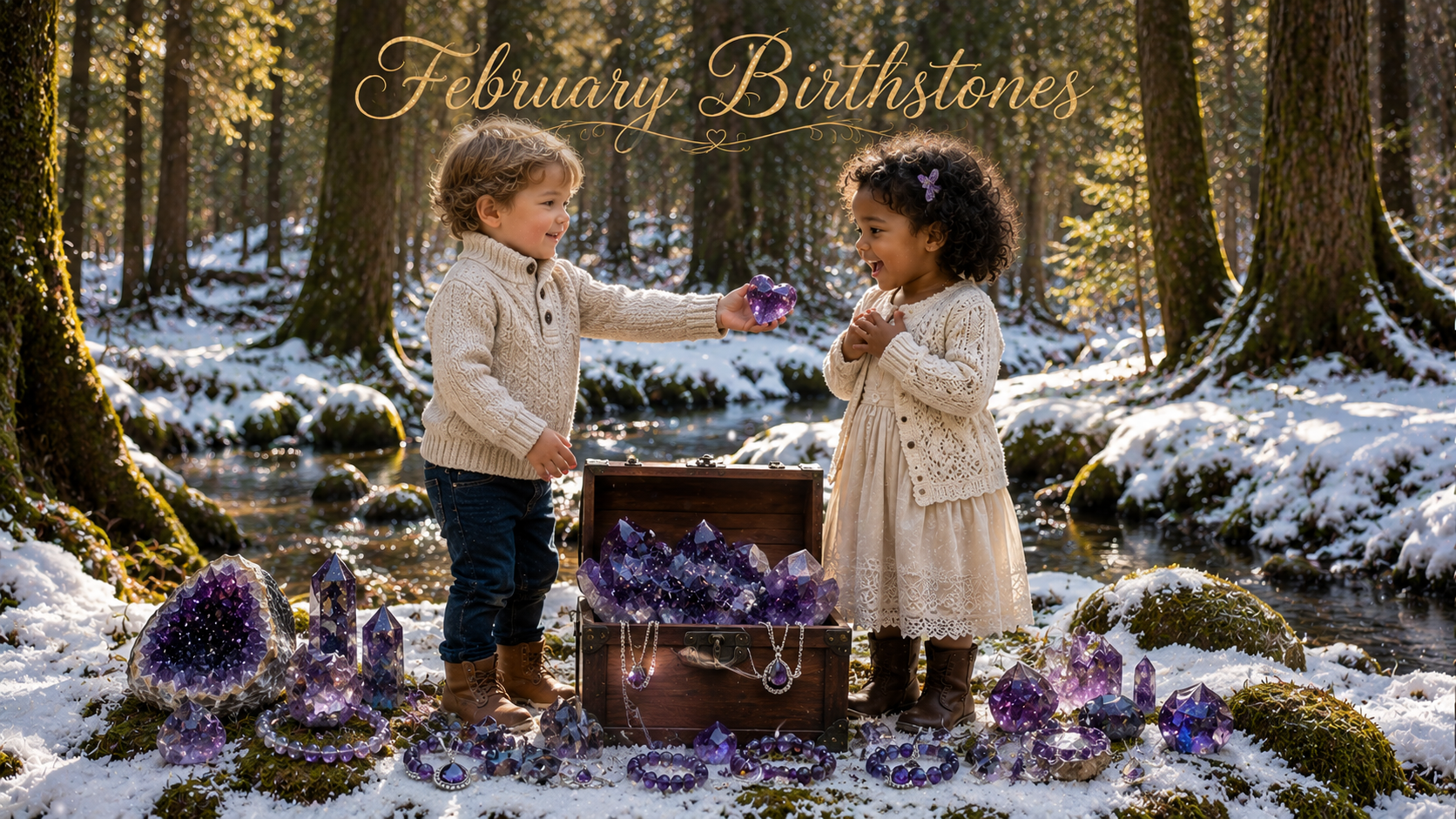
Amethyst holds February in the modern list, the traditional pre-1912 list, the Ayurvedic list and both biblical traditions — an unbroken run matched by no other month. Only the Tibetan and Hindu traditions name something else.
Primary (Modern): AMETHYST
Traditional (pre-1912): AMETHYST
Secondary: None Recognized
Mystical (Tibetan): Bloodstone
Ayurvedic: Amethyst
Hindu: Moonstone
Historical (Hebrew & Arabic): Amethyst
Zodiac Signs for February
Aquarius (January 20 – February 18) & Pisces (February 19 – March 20).
Our Birthstone Picks based on Zodiac
Aquarius — Amethyst
Aquarius lives in the upper registers — ideas, systems, futures, the shape of things that don't yet exist. The classic Aquarian difficulty is not a lack of insight but an excess of it: too many open channels, too much signal, not enough quiet.
Amethyst is a Crown and Third Eye stone that stills the mind and purifies the energy field, and that combination is what makes it right here. It does not add stimulation to a system already running hot. It clears.
The stillness is the active ingredient. Aquarius generates ideas faster than it can evaluate them, and what usually fails is not the thinking but the sorting — knowing which of twelve good ideas is the one worth building. Amethyst supports the kind of clarity that feels less like reasoning toward an answer and more like the answer arriving.
For a February-born Aquarius running on months of intellectual momentum, it offers the pause that makes the momentum useful.
Pisces — Amethyst
Amethyst is also our pick for Pisces, and our records mark it as the official Pisces birthday stone. The reasoning is almost the inverse of the Aquarian case.
Pisces is the most intuitive sign of the zodiac — permeable, imaginative, attuned to what other people feel before they say it. That permeability is both the gift and the cost. Pisces absorbs, and without something to purify the field, absorption becomes overwhelm and intuition becomes anxiety wearing intuition's clothes.
Amethyst does not amplify Pisces' sensitivity; the sign has no shortage. It clarifies it, so that what arrives can be distinguished from what was picked up along the way. It accelerates intuitive development while protecting the person doing the intuiting.
It is also a reliable stone for sleep and dreams, which addresses the Piscean perennial: a mind that will not close down at night. Wisdom, calm and protection together — Pisces needs all three and rarely finds them in one place.
All Stones of February
Amethyst
Primary, Traditional and Historical
Amethyst is the rarest kind of birthstone: one that has never been contested. It holds every tier February has, from the ancient lists through the traditional Polish list to the modern standard.
For those born in February, it works through the Crown and Third Eye chakras — the centres of higher consciousness and inner sight. It stills the mind, purifies the energy field, and opens the way to the kind of inner knowing that feels less like reasoning toward an answer and more like clarity simply arriving.
February people tend to sit between things: past the reset of January but not yet into spring, in the shortest and often heaviest month of the year. Amethyst suits that position. It is a stone of spiritual connection and protection, but also of calm and emotional balance, and it is one of the most reliable stones for sleep and dreams.
Worn through February, it accelerates intuition while keeping the person grounded enough to use it — insight that clarifies rather than unsettles.
Bloodstone
Mystical (Tibetan)
The Tibetan mystical list, dating to at least 1000 CE, gives February to bloodstone — deep green flecked with red, and a total contrast to amethyst in both colour and character.
Bloodstone has been called the Warrior's Stone since antiquity. It was carried through the Crusades and carved into amulets by Roman soldiers, and it is recognized across cultures as a stone of courage, fortitude and the strength of character required to act rightly under pressure.
Working through the Root and Heart chakras, it fortifies the body and stimulates the survival instinct.
For February-born people, that fills a genuine gap. February is the year's hardest month to endure rather than its hardest to survive — dark, long, and demanding in a low, grinding way that calm alone doesn't answer. Where amethyst quiets the mind, bloodstone supplies stamina.
For a February that needs fortitude more than peace, this is the stone the Tibetan tradition points to.
Moonstone
Hindu
The Hindu list, dating to around 1500 BCE, assigns February to moonstone — and of February's three traditions, this is the one that speaks to emotional weather.
Moonstone is the stone of new beginnings and of the wisdom that comes from honouring cycles rather than resisting them. It connects to lunar rhythm, soothes emotional instability, and stabilises the inner tides of feeling — not by flattening them but by making them legible.
That distinction is the whole of its value. Feelings move in cycles, and they are far easier to live with once that is accepted rather than fought.
For February-born people, the timing is apt. February is when the year's initial optimism meets its first real test, and when low mood is easiest to mistake for a permanent verdict rather than a season.
Its chakra association shifts with colour — Crown and Third Eye in the classic varieties, Sacral in the warmer ones — and it deepens the intuitive knowing most people experience but few learn to trust.
A Note on Sources
Every stone above comes from a documented birthstone list. The modern assignment derives from the 1912 National Association of Jewelers list as amended, confirmed by the GIA and the American Gem Society. The traditional assignment comes from the Polish list of the 16th to 18th centuries. The Mystical list is Tibetan and dates to at least 1000 CE; the Ayurvedic and Hindu lists originate in the Indus Valley around 1500 BCE. The Hebrew and Arabic assignments derive from readings of the Breastplate of Aaron following Josephus in the first century CE.
Amethyst's presence across all five Western traditions is unusual and worth noting: it is one of the few ancient gem names that maps cleanly onto a single modern mineral species, which is why its record is so consistent.
Disclaimer: The metaphysical properties of crystals are based on historical traditions and personal beliefs and are intended to support mindfulness and intentional living. They are not a substitute for professional medical, psychological, legal, or financial advice.