December Birthstones
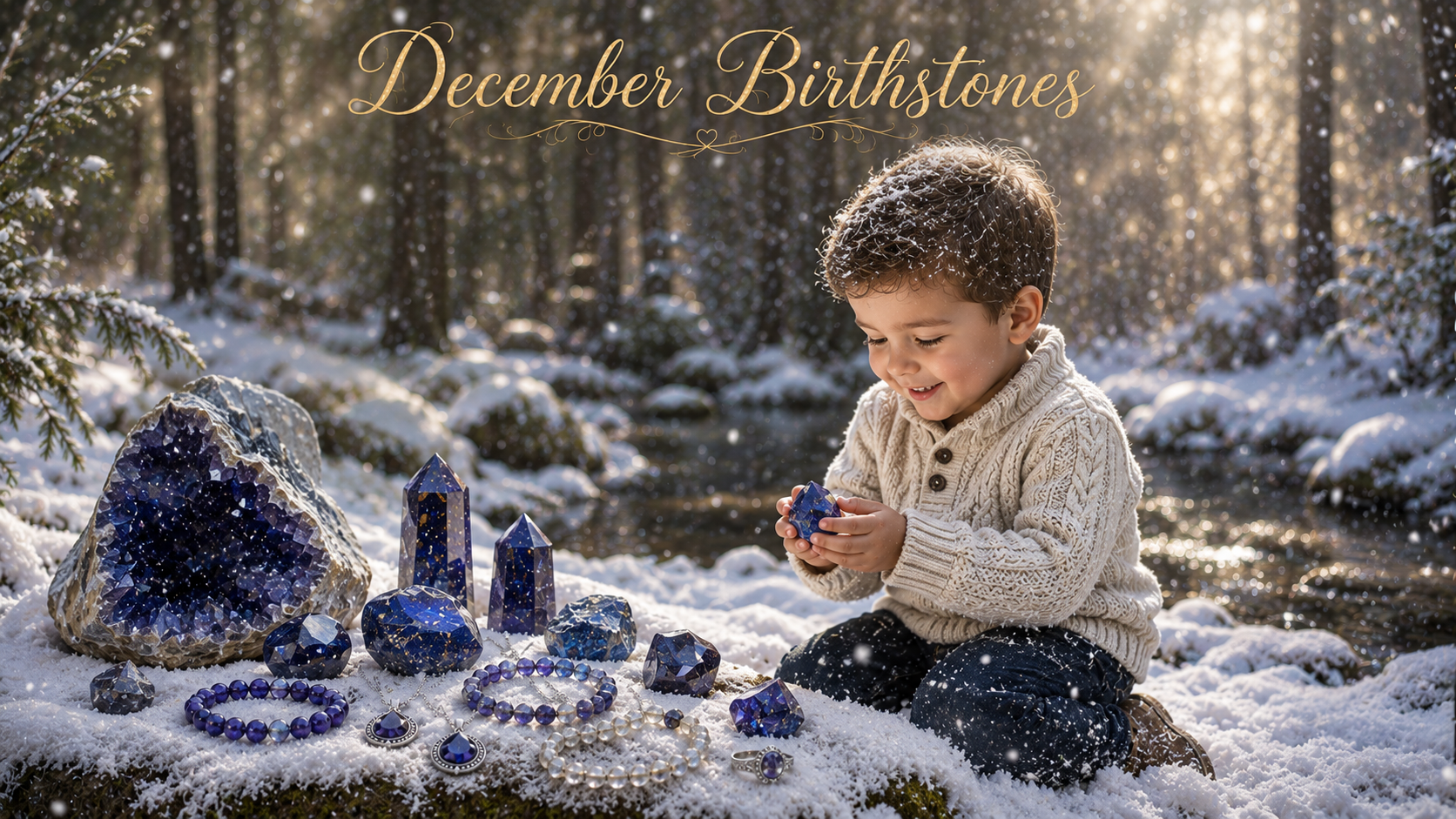
at a Glance
December carries more verified stones than any other month — seven across seven traditions, with almost no overlap between them. Turquoise holds both the modern and traditional positions, with lapis lazuli as its traditional companion, the stone that zircon and later tanzanite displaced. Tanzanite was added in 2002, making it the newest stone on any birthstone list.
Primary (Modern): TURQUOISE
Traditional (pre-1912): TURQUOISE, LAPIS LAZULI
Secondary (Modern): Zircon, Tanzanite
Mystical (Tibetan): Onyx
Ayurvedic: Ruby
Hindu: Topaz
Historical (Hebrew): Ruby
Historical (Arabic): Ruby
Zodiac Signs for November
Sagittarius (November 22 – December 21) and Capricorn (December 22 – January 19).
Our Birthstone Picks based on Zodiac
Sagittarius — Turquoise
Our records mark turquoise as the official Sagittarius birthday stone, and it is also December's primary and traditional stone — the strongest pairing on any page in this series.Sagittarius is the traveler of the zodiac, and turquoise has been the traveler's stone for as long as either has been written about: carried on trade routes, set into bridles, worn as protection by people a long way from home.The sign's defining quality is honesty. Sagittarius says the true thing, often before considering whether it needed saying, and it is the sign least willing to perform a politeness it does not feel. Turquoise works exactly there — a Throat chakra stone of honest self-expression and authentic communication.Its more useful gift, though, is self-forgiveness. The sign's bluntness lands badly often enough, and Sagittarius carries the aftermath longer than its cheerful reputation suggests. Turquoise is specifically associated with releasing self-recrimination rather than merely apologizing for it.
Capricorn — Ruby
Ruby is December's Ayurvedic stone and the assignment both biblical readings agree on. Our records also mark it as the official Capricorn birthday stone — a verified December assignment that independently matches the sign. Capricorn builds for duration. It is patient to a fault, willing to work at things whose payoff sits decades out, and quietly certain that anything worth having takes longer than other people are prepared to spend. What it rarely grants itself is warmth. Ruby works through the Root and Solar Plexus chakras, stirring the blood and promoting vitality — physical fuel rather than encouragement. For a sign that runs on discipline and tends to treat its own body as a resource to be spent, that grounding matters.Its second quality is the fiercest and most faithful kind of love. Capricorn feels this way and shows it rarely. Ruby is the stone that treats devotion as strength rather than as a distraction from the climb.
All Stones of December
Turquoise
Primary and Traditional
Turquoise holds both of December's principal tiers, and it is one of the most historically continuous stones in use anywhere. The pharaohs wore it, Chinese artisans carved it more than three thousand years ago, and it has been central to Persian and Southwestern American traditions for centuries.
For those born in December, it works through the Throat and Third Eye chakras. It is a stone of honest self-expression — the voice of the body, and the seat of authentic communication — and it has been carried as protection by travelers for millennia.
Its most distinctive quality is self-forgiveness. Turquoise is associated specifically with releasing self-recrimination, which sets it apart from the many stones that address how we treat other people and the comparatively few that address how we treat ourselves.
December is the month of accounting: the year closes, and people tend to audit themselves harshly in the process. Protection, honest speech, and permission to stop prosecuting your own case.
Lapis Lazuli
Traditional
Lapis lazuli is December's second traditional stone and the one the modern list quietly dropped, displaced first by zircon and then by tanzanite. It deserves better than that footnote.
It has been treasured for more than six thousand years: ground into ultramarine pigment for sacred art, worn by pharaohs as a stone of divine truth, and carved into amulets symbolizing a royal wisdom and honest judgment that could not be purchased or performed.
For December-born people, it works through the Throat and Third Eye chakras, and its emphasis is integrity — the alignment of what you know with what you say. Where turquoise addresses honesty as expression, lapis addresses it as character.
That suits December's reflective character. The year's end invites a fairly unsparing look at the gap between stated intentions and actual conduct, and lapis is the stone for closing it rather than explaining it away.
Zircon
Secondary (Modern)
Zircon entered December's modern list as a replacement for lapis lazuli, and it is the most geologically remarkable stone on this page. Specimens have been dated to over four billion years, making it among the oldest minerals ever identified.
For December-born people, that age is not a trivia point but the substance of what it offers. Zircon carries an energetic depth that appears to match its geological history, providing a connection to wisdom and spiritual grace that feels settled rather than sought.
Working primarily through the Crown chakra, it is associated with virtue, spiritual clarity and compassion, and it has an unusually strong link to lucid dreaming — making it a natural stone for the year's longest nights.
Colorless zircon has been confused with diamond for centuries because of its brilliance and fire, a fair emblem for a stone that has spent most of its history being mistaken for something else.
Tanzanite
Secondary (Modern)
Tanzanite is the newest stone on any birthstone list, added to December in 2002, and one of the rarest on Earth — found in a single location at the foot of Mount Kilimanjaro, in a deposit widely expected to be exhausted within decades.
For December-born people, its energy matches that rarity. Tanzanite carries a blue-violet frequency that stimulates the Throat, Third Eye and Crown chakras simultaneously — an unusual combination and a powerful one. Most stones open one of those centers. Tanzanite opens the whole upper channel at once.
The result is a stone of spiritual awakening and transformation, and it is more intense than the rest of December's collection. It belongs to a month when something is genuinely changing rather than to routine daily wear.
December is the natural month for exactly that. The year ends, and the question of what the next one is for gets asked whether or not anyone is ready.
Black Onyx
Mystical (Tibetan)
The Tibetan mystical list, dating to at least 1000 CE, gives December to onyx, which we carry as black onyx — the deep, uniformly dark variety.
It is a Root chakra stone, and its character is containment rather than expansion. Where December's blue stones open the throat and the upper centers, black onyx holds. It is associated with steadiness under pressure, with the retention of personal energy rather than its outward spending, and with the discipline to see something through without announcing it.
For December-born people, that addresses the month's real cost. December is relentlessly outward — social, obligated, demanding of presence — and the people who give most through it are frequently the ones with least left in January.
Our records also list Capricorn among its signs, which makes it a natural companion for December's Capricorn half.
For a December that needs conserving rather than spending, this is the Tibetan tradition's answer.
Ruby
Ayurvedic and Historical
Ruby carries three of December's tiers: the Ayurvedic assignment and both biblical readings. It is the only stone in the month's collection that is warm rather than cool, and the traditions that name it are the oldest ones.
For December-born people, it works through the Root and Solar Plexus chakras — a combination pairing raw vitality with personal will. Ruby stirs the blood, promotes physical energy, and builds the kind of self-confidence that comes from the body rather than from reassurance.
Its second quality is devotion: the fiercest and most faithful kind of love, protective rather than merely passionate.
The seasonal logic is easy to read. December is the darkest and coldest stretch of the northern year, and the older traditions answered it with the reddest stone available — heat, blood and vitality set against the season rather than harmonized with it.
For a December that needs warming rather than quieting, ruby is the ancient choice.
Topaz
Hindu
The Hindu list, dating to around 1500 BCE, assigns December to topaz — the same stone the modern list gives to November, which is a useful reminder that month boundaries are conventions rather than facts.
Topaz has been called the true stone of joy by the ancients, and the mechanism is specific: it operates through the law of attraction, drawing toward the wearer the particular goodness that aligns with their sincere intention rather than their wishful thinking.
Its chakra action depends on color. Golden topaz activates the Solar Plexus and Crown together, joining personal will to a higher perspective. The blue variety works through the Throat and Third Eye, which places it squarely in December's territory of communication and insight.
For December-born people, that makes it an unusually flexible stone — one that can be chosen by color to suit either the month's reflective side or its resolving side.
Joy, abundance and intention that has been examined.
A Note on Sources
Every stone above comes from a documented birthstone list. The modern assignment derives from the 1912 National Association of Jewelers list as amended, confirmed by the GIA and the American Gem Society; tanzanite was added in 2002. The traditional assignment comes from the Polish list of the 16th to 18th centuries. The Mystical list is Tibetan and dates to at least 1000 CE; the Ayurvedic and Hindu lists originate in the Indus Valley around 1500 BCE. The Hebrew and Arabic assignments derive from readings of the Breastplate of Aaron following Josephus in the first century CE.
December has the widest spread of any month: turquoise, lapis lazuli, zircon, tanzanite, onyx, ruby and topaz, with only ruby appearing in more than one tradition. Ancient gem names described color and appearance rather than mineral species, and the ancient "ruby" would have covered several unrelated red stones. We record these traditions as traditions, not as established fact.
Disclaimer: The metaphysical properties of crystals are based on historical traditions and personal beliefs and are intended to support mindfulness and intentional living. They are not a substitute for professional medical, psychological, legal, or financial advice.